BOM
BOM Cart()
 English
 Russia
 Korean
Microchip Technology recently introduced its new PIC32CM PL10 family, featuring its new line of Arm Cortex-M0+ microcontrollers aimed at industrial control, building automation, consumer appliances, and sensor-based systems. These new MCUs operate from 1.8 V to 5.5 V, but support 5 V environments.

PIC32CM PL10 32-bit Arm Cortex-M0+ MCU in a compact package, designed for 5-V-capable embedded systems with an AVR-compatible pinout.
Many embedded designs still rely on 8-bit AVRs because they’re predictable, cost-effective, and well understood. However, as applications demand more processing power, with smarter control loops, richer user interfaces, or tighter communication timing, 8-bit cores will soon be overloaded. Microchip designed the PL10s to address these upcoming gaps by offering 32-bit performance in a format that looks very familiar to existing AVR users.
A Straightforward Migration Path
One of the most practical details of the family is its pin-to-pin compatibility with AVR MCUs. Engineers can upgrade to a 32-bit Cortex-M0+ device while keeping the same PCB layout and pin assignments in many cases.
That matters in high-volume production. A full board redesign can trigger new EMC testing, layout validation, and, in some cases, mechanical changes. By maintaining the same footprint, Microchip enables teams to reuse proven hardware and focus on firmware updates. The jump to 32-bit becomes a performance upgrade rather than a platform reset.
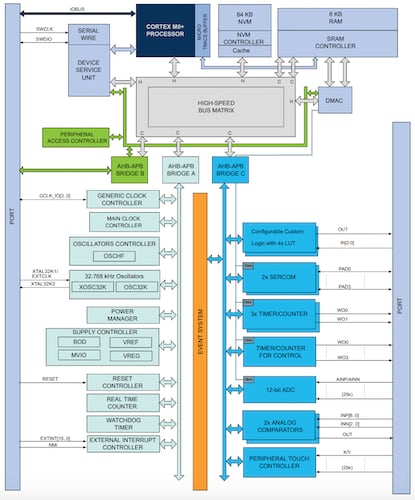
Typical block diagram for the PIC32CM6408PL10028/032/048/064. (Go to page 12 of the datasheet for enlarged image).
The Cortex-M0+ core runs at up to 24 MHz and supports CMSIS, enabling modular and reusable code. While developers working in MPLAB can stay within Microchip’s ecosystem, the PL10 is also compatible with tools like VS Code, IAR, Arm Keil, SEGGER, Zephyr, and MikroElektronika.
Mixed Voltages, Fewer Components
Mixed-voltage systems are common in embedded designs, and the PIC32CM PL10 (datasheet linked) addresses this with integrated multi-voltage I/O (MVIO). The MVIO allows separate I/O domains to operate at different voltages simultaneously, ranging from 1.8 V to 5.5 V. This advantage enables lower-voltage devices to be connected to the same system without additional hardware. The end result is a system that has reduced part count and simplified routing.
Safety Considerations at the Entry Level
The PL10 family supports functional safety standards, including ISO 26262 and IEC 61508. This is notable for an entry-level Cortex-M0+ device, since compliance with these standards is required in automotive, industrial, and appliance applications. Aligning the MCU architecture with these frameworks makes the family a candidate in designs that may require formal safety assessment or certification.
The new MCUs also integrate a peripheral touch controller and a 12-bit ADC for capacitive touch and analog measurement. These features support noise-tolerant sensing in electrical systems. In addition, core-independent peripherals (CIPs) can execute repetitive or timing-critical functions without continuous CPU involvement, improving timing determinism and reducing system power consumption in control-oriented applications.
All images used courtesy of Microchip.

EA-CHIP INDUSTRY CO., LIMITED
-
Tel
+86 180 2549 2789 -
Wechat