BOM
BOM Cart()
 English
 Russia
 Korean
In the mid-1960s, digital electronics was at an inflection point where discrete transistor logic worked, but it was bulky, inconsistent, and difficult to scale. Integrated circuits existed, but there was no dominant logic family that balanced speed, cost, noise margins, and manufacturability. That changed when Texas Instruments introduced the SN7400 series of transistor-transistor logic (TTL), bringing a standardized, catalog-driven approach to digital design.

TI's SN7400N chip includes four two-input NAND gates. Image used courtesy of Audrius Meskauskas via Wikimedia Commons (CC BY-SA 3.0)
The SN7400 itself was unassuming, with a quad two-input NAND gate in a 14-pin dual in-line package, but it arrived as part of a broader strategy. TI paired a well-defined electrical interface with plastic packaging and aggressive pricing, turning logic functions into interchangeable building blocks. By the late 1960s and into the 1970s, 7400-series TTL had become the default choice for minicomputers, peripherals, instrumentation, and early microprocessor systems.
A Logic Primitive That Scaled
The importance of the SN7400 lies less in the NAND gate it implements than in what that gate represents. NAND is functionally complete, and any combinational or sequential logic function can be built from it. By placing four identical NAND gates in one package, TI gave designers a universal primitive they could replicate endlessly.
Electrically, the standard 7400-series TTL was tightly defined. Devices operated from a nominal 5-V supply, with guaranteed input thresholds around 0.8 V for logic low and 2.0 V for logic high. Outputs were actively driven high and low using a totem-pole, or push-pull, stage, which reduced output impedance and delivered faster switching than earlier resistor-loaded logic.
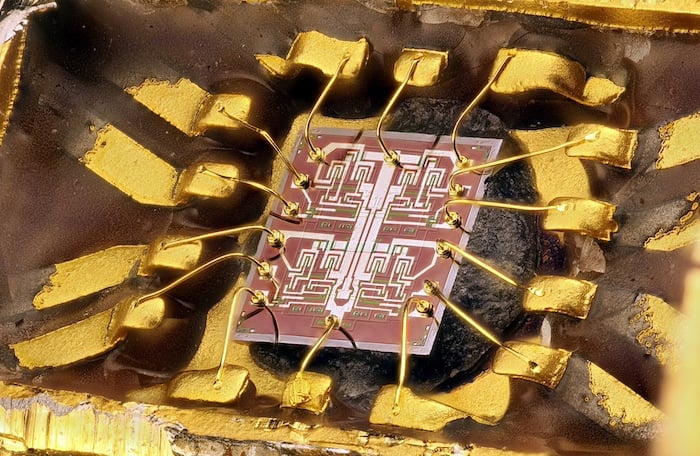
TI's SN7400 die in the original flat package. Image used courtesy of Mister rf via Wikimedia Commons (CC BY-SA 4.0)
That totem-pole output was both a strength and a constraint. It enabled speed, but it meant outputs could not be tied together without care. This drove the creation of variants with open-collector outputs for wired logic and, later, three-state outputs for shared buses. What mattered was that all these variants shared the same numbering scheme. A 7400 NAND, a 7404 inverter, a 74138 decoder, or a 7474 flip-flop all shared a common electrical philosophy.
Texas Instruments also split the family by environment, with SN54xx parts rated for military temperature ranges, while SN74xx parts targeted commercial and industrial use. Functionally, they were the same, and it’s exactly that consistency that allowed designs to migrate from lab benches to fielded systems without rethinking logic.
Building Systems One Package at a Time
The real impact of the 7400-series came from its breadth. TI and its competitors rapidly expanded the catalog, moving from simple gates to medium-scale integration. Counters, shift registers, multiplexers, latches, and arithmetic units appeared, all designed to interoperate electrically and mechanically.
For system designers, this changed the workflow. Instead of designing logic at the transistor level, engineers designed with part numbers. A timing path might be a 7404 feeding a 74123 monostable, clocking a 7490 counter. Debugging often meant probing pins with a logic probe or oscilloscope and replacing a suspect DIP. Schematics grew dense with rectangles labeled “74xx”—but they were readable and modular.
TTL’s power consumption was by no means marginal; a standard SN7400 could draw tens of milliamps depending on state and load, which added up quickly in large systems. The tradeoff was predictable behavior and strong noise margins compared with early MOS logic, and this mattered in an era of long backplane traces and imperfect grounding.
Variants, Clones, and Longevity
By the late 1970s, the original 7400-series had spawned numerous subfamilies. Low-power Schottky variants reduced power draw while increasing speed, while advanced, fast TTL pushed propagation delays even lower. Later, BiCMOS derivatives blurred the line between TTL and CMOS while preserving compatibility. The numbering scheme endured, even as the silicon underneath changed.
Second sourcing was another factor in the family’s dominance. Once the 7400-series became ubiquitous, other manufacturers produced pin-compatible versions. The part numbers stayed recognizable, reinforcing the idea that a “7400” was a function first and a vendor second. This ecosystem made TTL a safe choice for long-lived designs.
Over time, CMOS logic families overtook TTL in terms of power efficiency and voltage flexibility. Yet the conceptual framework that TTL established remained. The idea that digital logic could be composed from standardized, well-documented blocks became foundational. Even today, engineers speak in the shorthand of “a NAND gate here” or “a flip-flop there”—language shaped by decades of 74xx schematics.
Sure, the SN7400 and its relatives were not glamorous components. While they did not introduce a single dramatic breakthrough, they did standardize digital logic at a time when the industry needed stability, and they did so in a way that scaled from single boards to entire systems.

EA-CHIP INDUSTRY CO., LIMITED
-
Tel
+86 180 2549 2789 -
Wechat