BOM
BOM Cart()
 English
 Russia
 Korean
Infineon Technologies has announced a new product family of isolated gate driver ICs, the EiceDRIVER 1ED301xMC12I. The three variants—the 1ED3010, 1ED3011, and 1ED3012—were each designed to operate silicon MOSFETs, IGBTs, and SiC MOSFETs, respectively.

The 1ED301xMC12I family.
These devices contain opto-emulator inputs and are pin-compatible with existing opto-emulators and optocouplers. With this release, Infineon aims to capitalize on the growing SiC market and power electronics applications in solar, motors, and energy storage.
Key Electrical Characteristics of EiceDRIVER ICs
The IC components in the 1ED301xMC12I family (datasheet linked) are single-channel isolated gate drivers with integrated galvanic isolation. The product family contains three variants with identical features targeting different use cases: the 1ED3010 for silicon MOSFETs, 1ED3011 for IGBTs, and 1ED3012 for SiC MOSFETs. Infineon provides the devices in six-pin CTI 600 and six-pin DSO packages (8-mm creepage) as drop-in replacements for six-pin optocouplers.
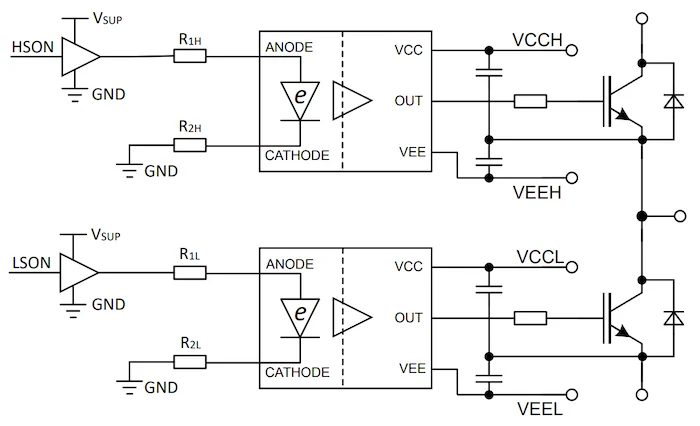
Diagram of the 1ED301xMC12I EiceDRIVER opto-emulator gate driver IC.
The devices can operate at an output current of 6.5 A (typical), and their power supply side output has a voltage rating of 35 V (absolute max). Infineon recommends an input forward current of 5.5 mA–15 mA (20 mA max) on the diode high-side (“ON”) with an input voltage of -15 V–0.9 V on the diode low-side (“OFF”). Output undervoltage (UVLO) and active shutdown are included in the IC as protection features. These devices operate at temperatures between -40°C and 150°C, and have been validated for industrial applications under JEDEC JESD47, JESD22, and J-STD-020.
Transformer Opto-Emulation and PMOS Current Sourcing
As isolators, these devices have a common-mode transient immunity (CMIT) of over 300 kV/μs, a 40-ns propagation delay, and propagation-delay matching of ±10 ns. The isolation features have been safety-certified to UL 1577, with a VISO of 5.7 kV (RMS) for 60 s. Infineon has planned for IEC 60747-17 certification with VIORM at 1,767 V (peak) to check its reinforced insulation. Infineon claims that these metrics provide best-in-class robustness.

Block diagram of the 1ED301xMC12I ICs.
The opto-emulators in the 1ED301xMC12I chips utilize coreless transformers to transfer data across the isolation barrier. The input stage mimics the anode and cathode of a diode, but does not transmit using light like conventional optocouplers and isolators. Instead, the chip utilizes coupled magnetic fields through transformers. This change in the transfer mechanism likely provides better isolation and accounts for the 1ED301xMC12's high CMTI.
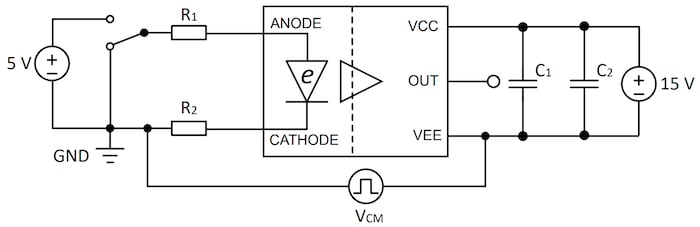
CMTI test circuit.
On the output side, Infineon designed the current-sourcing stage of the gate driver IC using PMOS-only MOSFETs. Typical MOSFETs deliver peak current at the initial transition stage. PMOS sustains a strong sourcing current across the gate voltage up to VCC. This allows these ICs to have fast turn-on rates. The combination of these features allows precise and robust switching and an improved turn-on performance.
Drop-In Compatibility With Legacy Opto-Isolation Devices
Opto-emulators and optocouplers are commonly used in power electronics circuits for applications like motor drives, solar inverters, EV chargers, and energy storage devices. Existing designs often utilize an opto-based control scheme to provide galvanic isolation between the input and output.
In recent years, there has been significant interest in switching to SiC technology in power electronics applications. SiC MOSFETs outperform traditional silicon MOSFETs in high-voltage, high-temperature, and high-frequency applications, resulting in improved efficiency. However, migrating to SiC technology may require modifying existing opto-based control schemes and designing around SiC gate drivers.
Infineon targeted the 1ED301xMC12I product family with this value proposition in mind. The devices have pin-to-pin compatibility with standard six-pin optocouplers/isolators, making them drop-in replacements for existing designs using IGBTs or silicon MOSFETs. The 1ED3012 device is SiC-compatible and can be used as input-isolated gate drivers for designers who plan to use SiC devices.
Two Pins, Two Traces
The 1ED301xMC12I utilizes a two-pin input. Infineon claims that this leads to better noise performance. A typical six-pin or eight-pin input-isolated IC requires at least three pins: Vsup, GND, and PWM. To maximize performance, these pins typically require external filters such as a decoupling capacitor between Vsup and GND or an input filter for the PWM.

EA-CHIP INDUSTRY CO., LIMITED
-
Tel
+86 180 2549 2789 -
Wechat