BOM
BOM Cart()
 English
 Russia
 Korean
By the early 1970s, integrated circuits had already reshaped calculators and logic boards, but control systems still relied on clusters of chips. A controller typically meant a small CPU or state machine, external ROM, some RAM, and glue logic for scanning inputs and driving outputs. In 1974, Texas Instruments collapsed that entire arrangement into one component with the TMS1000.

Texas Instruments' TMS1000. Image used courtesy of Christian Bassow via Wikimedia Commons (CC BY-SA 4.0)
The TMS1000 targeted cost-sensitive embedded control rather than general-purpose computing. It found use in appliances, toys, instruments, and terminals that needed deterministic behavior, minimal external parts, and a fixed program. In doing so, it set expectations for what a microcontroller should be long before that term was widely used.
A Calculator Heritage Turned Controller
The TMS1000 grew directly out of TI’s calculator work. Earlier single-chip calculator devices had already demonstrated that a small processor, display drivers, and key scanning could live together on one piece of silicon. The TMS1000 generalized that idea and sold it as a customer-programmable controller, with the program defined by a mask during wafer fabrication.
Architecturally, it was a four-bit microcomputer built in PMOS technology. The baseline device integrated 8,192 bits of ROM, organized into 1,024 eight-bit instruction words, and 256 bits of RAM arranged as 64 four-bit words. Program and data storage were separate, giving it a Harvard-style organization that simplified timing and control. An accumulator-centric ALU handled arithmetic and logic, while a small set of registers selected RAM files and addresses.
Clocking was modest even by the standards of the time. Typical operating frequencies sat in the hundreds of kilohertz, with instruction cycle times on the order of tens of microseconds. Power came from a negative supply, usually around -15 V, reflecting its PMOS roots. None of this was accidental; the device was designed to be inexpensive to manufacture and tolerant of simple external circuitry, not to compete with emerging 8-bit microprocessors.
What distinguished the TMS1000 was the amount of system logic it absorbed. Alongside the CPU and memory sat input and output structures tailored for real-world control tasks. Four K inputs read parallel data, commonly wired into a key matrix. R outputs acted as latched strobes and control lines, while O outputs were generated through a programmable logic array that could be customized during mask creation. This made it possible to scan keyboards, multiplex displays, and drive indicators with little more than resistors and transistors on the board.
Mask Programming and Embedded Assumptions
Unlike later microcontrollers, the TMS1000 was not field-programmable. Its ROM contents were fixed at manufacture, using a mask that encoded the customer’s program. Texas Instruments built an ecosystem around that, with development flowing from assembly and simulation to prototype masks, then to volume production once the design was frozen. That workflow made sense for products shipping in the tens or hundreds of thousands.
The instruction set reflected this: compact, with a few dozen core operations covering data movement, arithmetic, branching, looping, and I/O control. Instructions were encoded into eight bits, and some decode behavior could itself be altered through mask options. That level of customization blurred the line between software and hardware in a way that feels foreign today but was practical for high-volume consumer electronics.
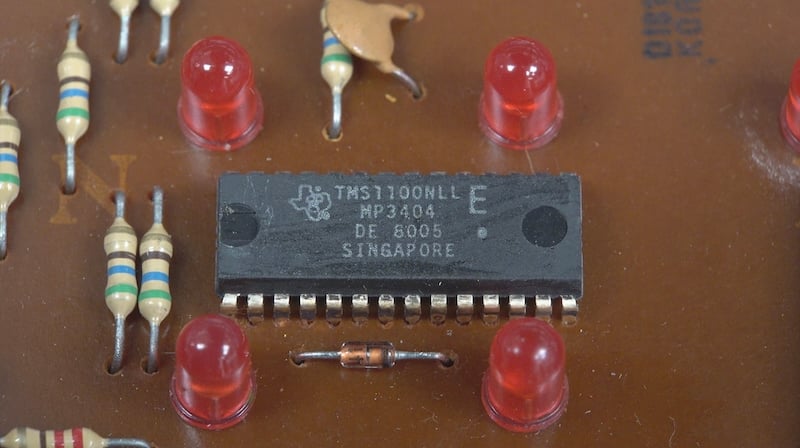
The TMS1100 MCU in the Parker Brothers Merlin electronics game. Image used courtesy of Binarysequence via Wikimedia Commons (CC BY-SA 4.0)
In terms of electrical behavior, its outputs were open drain, with optional pull-down characteristics defined at manufacture. This allowed the device to interface with higher-voltage loads and multiplexed displays without complex drivers. Variants in the family extended these capabilities further, including parts intended to drive high-voltage display elements directly and later members that doubled ROM and RAM capacity.
All of this made the TMS1000 less flexible than later microcontrollers but extremely efficient at its intended jobs. It assumed the designer knew exactly what the product would do and that the behavior would not need to change after release.
From Toys to an Entire Category
The impact of the TMS1000 is best measured by where it appeared. Texas Instruments used it internally in products such as the Speak & Spell, where it handled input scanning, sound generation control, and display management. Beyond TI’s own catalog, the device and its derivatives found homes in games, appliances, cash registers, alarm systems, and industrial controls. These might not have been prestige systems, but they shipped in enormous numbers.
The TMS1000 demonstrated that a single chip could serve as a complete controller, not just a calculator brain, and it’s exactly that success which encouraged TI and others to expand the concept. Later, families moved to NMOS and CMOS processes, adopted single-positive supplies, added RAM and ROM, and eventually embraced field-programmability. By the late 1970s, 8-bit microcontrollers with more conventional programming models entered the market, but they inherited the assumption that CPU, memory, and I/O belonged together.
In retrospect, the TMS1000 was not about performance or elegance but integration at the right level for the problem at hand. By fitting control logic onto one chip and making it economical at scale, Texas Instruments turned a collection of parts into a product category.

EA-CHIP INDUSTRY CO., LIMITED
-
Tel
+86 180 2549 2789 -
Wechat