BOM
BOM Cart()
 English
 Russia
 Korean
Where conventional TVS diodes fall short, the new circuit protection device offers continuous clamping voltage across current and temperature conditions.
Semtech recently released the TDS5311P circuit protection device to address a problem that is increasingly common as USB Power Delivery moves into higher-power systems. As Extended Power Range pushes VBus up toward 48 V and beyond, protection schemes that worked at lower voltages are starting to break down.

The 2.0 mm × 2.0 mm DFN package reduces board space while maintaining high surge capability.
Traditional TVS diodes don’t behave consistently at these levels, especially under varying current and temperature conditions. The TDS5311P is designed to deal with that directly, providing protection for VBus lines operating up to 53 V in systems where reliability is no longer optional.
Where the Protection Gap Comes From
USB PD EPR is pushing higher voltages into environments that were never designed for it. Industrial equipment, rugged mobile devices, and high-performance portable systems all bring different electrical conditions, but they share the same issue once voltage climbs.
Conventional TVS diodes clamp differently depending on current and temperature. That variation might be manageable at lower power levels, but at 48 V, it becomes harder to predict how much stress downstream components are actually seeing.
That lack of consistency is the problem. It’s not just about absorbing a surge. It’s about knowing what happens during that surge.
Why Near-Constant Clamping Changes Things
The TDS5311P (datasheet linked) is built on Semtech’s SurgeSwitch architecture, which uses a surge-rated FET instead of relying on the behavior of a traditional diode. During a transient event, the device switches on and conducts current to ground, but the key difference is how it clamps. Instead of drifting with current and temperature, it holds a near-constant clamping voltage from the start of the surge through peak current.
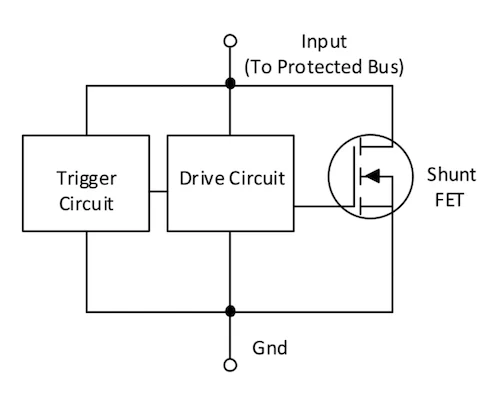
The SurgeSwitch architecture uses a FET-based path to control transient current and maintain consistent clamping behavior.
That changes how protection is handled in practice. Designers get a more predictable ceiling on voltage stress, which makes it easier to protect sensitive ICs downstream. It also reduces the margin guessing that typically comes with TVS-based designs. That consistency matters more than peak ratings alone in systems where failure isn’t acceptable.
Power Density That Actually Matters
The TDS5311P can handle 1,512 W of peak pulse power and up to 24 A. All of that sits in a 2.0 mm x 2.0 mm DFN package. That matters because board space is always tight, especially in industrial and portable systems where protection components have to fit around everything else.
Being able to keep that level of surge capability in a package this small gives designers more room to work with and makes layout a lot less restrictive. It also replaces larger SMAJ and SMBJ packages, freeing up board space while maintaining or improving protection performance.
Built for Real Electrical Conditions
The TDS5311P is designed around the kind of events that actually happen in the field, not just ideal test conditions. It handles high ESD levels, supports fast transient events, and meets industrial surge requirements without relying on oversized protection components.
Those ratings align with what you see in real systems, and, more importantly, they show that the device is built to withstand repeated stress. It also operates across a -40°C to +125°C temperature range, so behavior stays consistent even when conditions shift.
Why This Fits USB PD EPR Systems
As USB Type-C and USB PD move into higher-power applications, expectations around protection change with them. It’s no longer enough to just clamp voltage. The behavior during that event needs to be controlled and predictable.
Semtech aims the TDS5311P at that shift. It protects VBus lines up to 53 V while maintaining consistent clamping behavior across operating conditions. That makes it a better fit for systems where power density, reliability, and board space are under pressure simultaneously.
Where It Lands
This device isn’t trying to replace every protection solution. It targets a specific problem that occurs when voltage and power levels enter EPR territory. By maintaining consistent clamping behavior, handling high surge energy, and fitting into a very small footprint, the TDS5311P gives designers a more controlled way to protect modern USB power systems.
As those systems continue to scale, that kind of predictability becomes less of a feature and more of a requirement.
All images used courtesy of Semtech.

EA-CHIP INDUSTRY CO., LIMITED
-
Tel
+86 180 2549 2789 -
Wechat