BOM
BOM Cart()
 English
 Russia
 Korean
Engineers at the University of California San Diego (UCSD) have developed a new chip design that replaces traditional magnetic inductors with piezoelectric resonators for DC-DC step-down power conversion.
Published in Nature Communications, the research demonstrates a prototype that converts 48 V down to 4.8 V, a conversion ratio commonly required in data center power distribution, with a peak efficiency of 96.2%.

The step-down converter prototype strategically arranges a piezoelectric resonator with commercially available capacitors.
The work addresses a growing bottleneck in power delivery for GPU-heavy computing facilities, where conversion losses accumulate across thousands of individual power modules and represent a significant share of total energy waste.
A Hybrid Approach to Piezoelectric Conversion
Modern data centers typically distribute power at 48 V, but the GPU processors that drive AI training and high-performance computing workloads require much lower voltages, typically between 1 V and 5 V.
Bridging that gap efficiently is a fundamental engineering challenge, and existing technology handles it with diminishing returns. Conventional step-down converters rely on magnetic inductors, components that have been optimized over decades but are now approaching fundamental physical limitations in power density and efficiency.
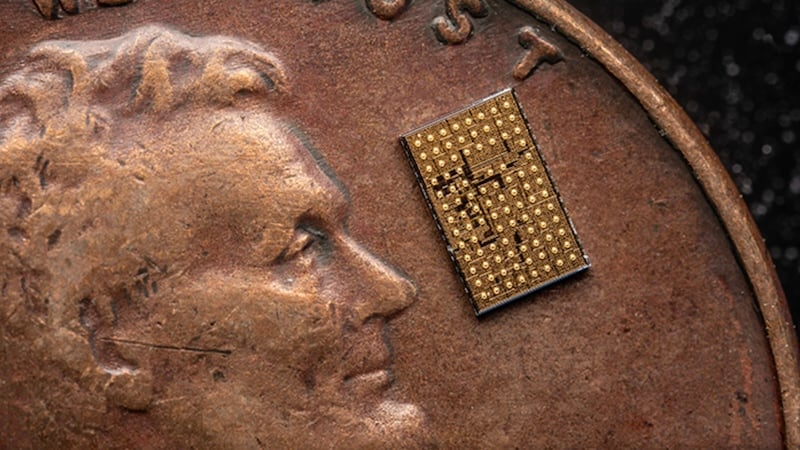
The DC-DC step-down conversion chip is shown on a U.S. penny for scale.
The UCSD team took a different approach, building a hybrid circuit that pairs a piezoelectric resonator with small, commercially available capacitors. Piezoelectric devices store and transfer energy through mechanical vibrations rather than magnetic fields, offering a fundamentally different mechanism for voltage conversion. By combining a resonator with strategically arranged capacitors, the researchers created multiple pathways for power to flow through the circuit. This configuration reduces energy wasted as heat and eases the electrical and mechanical stress on the resonator itself.
The result is a converter that delivers roughly 4x the output current of earlier piezoelectric designs, with only a modest increase in physical size. The 96.2% peak efficiency at a 10:1 step-down ratio is competitive with existing inductor-based converters operating at similar conversion points, but the researchers argue the technology has considerably more headroom for improvement, given how early it is in its development cycle.
Why Piezoelectrics Could Outpace Inductors
Magnetic inductors face inherent trade-offs with size, efficiency, and heat dissipation that become more constraining as power densities increase and physical space shrinks. Piezoelectric resonators, by contrast, offer potential advantages in energy density, miniaturization, and manufacturing scalability.
The technology does face practical hurdles before it can move from the lab to production. Piezoelectric resonators vibrate physically during operation and cannot be soldered using conventional reflow methods, which means new integration and packaging strategies will need to be developed before commercial deployment becomes realistic. Future work will focus on improving piezoelectric materials, refining circuit topologies, and developing packaging solutions that accommodate the resonator's mechanical behavior while maintaining compatibility with standard printed circuit board assembly processes.

PCB surrounded by capacitors used to test the DC-DC step-down conversion chip. A piezoelectric resonator is mounted beneath the board and electrically connected to the chip.
If the approach scales as the researchers expect, the payoff for data centers could be substantial. Even small efficiency gains in voltage conversion, when multiplied across the thousands of converters operating inside a single facility, translate to meaningful reductions in total power consumption and waste heat, both of which are major cost drivers as computing infrastructure continues to expand.
Data centers already consume a significant and growing share of global electricity, and power conversion losses are among the largest sources of wasted energy within those facilities. A viable alternative to magnetic inductors that can improve efficiency while shrinking the physical footprint of power delivery hardware would address two of the most pressing constraints facing data center designers today.
All images used courtesy of the David Baillot/UC San Diego Jacobs School of Engineering.

EA-CHIP INDUSTRY CO., LIMITED
-
Tel
+86 180 2549 2789 -
Wechat