BOM
BOM Cart()
 English
 Russia
 Korean
Recently Siemens announced Solido Characterizer, the latest addition to its Solido Characterization Suite, at its U2U EU event in Munich. Developed for foundries and in-house chip design teams, the software targets library characterization workflows across all process nodes, offering what Siemens says is a seven times improvement in throughput for Liberty file generation.
Library characterization is the process of creating the timing, power, and noise models that digital design tools rely on to evaluate circuit behavior. As process technologies shrink, corner counts grow, and emerging formats like the Liberty Variation Format (LVF) add statistical variation data to every library, generating accurate Liberty files has become a bottleneck that can delay tapeout schedules.
A single characterization run at an advanced node may require simulations across hundreds of process, voltage, and temperature corners, and Solido Characterizer uses predictive AI to compress that timeline from weeks to days.
Two Engines, One Seven Times Speedup
The seven times throughput is achieved through two complementary technologies. The first is a faster AI engine that drives Liberty generation for multi-PVT creation and applies advanced LVF techniques, delivering a five times speedup on its own. LVF captures statistical variation data at the library level, and its growing adoption has added substantial complexity to every characterization run. The AI engine accelerates the generation of the large datasets LVF requires, handling both standard timing and power data and the newer variation-aware formats.
The second contributor is Solido LibSPICE, which Siemens describes as the industry's first purpose-built, AI-accelerated simulator for characterization workloads. General-purpose SPICE simulators handle a wide range of circuit analysis, but characterization involves running large numbers of structurally similar simulations across many corners with slight parameter variations. LibSPICE exploits that regularity, providing an additional two times or greater performance boost.
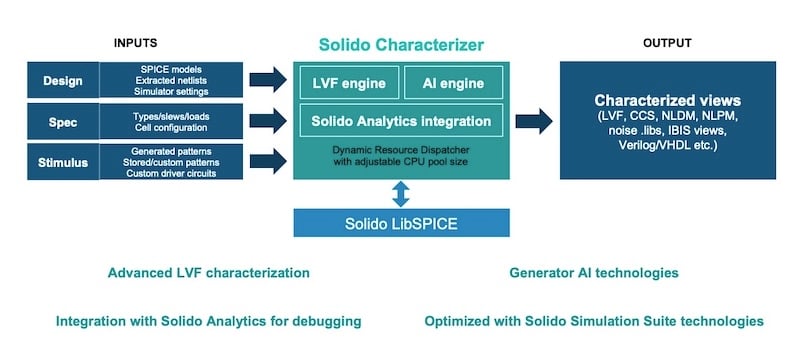
Solido Characterizer provides high-performance, high-throughput, modern standard cell library characterization.
Solido Characterizer also integrates with Solido Analytics, giving engineers real-time quality assurance of results, resource monitoring for in-progress runs, and automated rerun capabilities. Engineers can catch issues during characterization rather than discovering them downstream during signoff, reducing the costly cycle of generating a library, finding errors late, and re-running the entire flow. More information is available in the Solido Characterization Suite fact sheet.
Generative AI Enters the Characterization Flow
Beyond the speedup, Siemens is layering generative and agentic AI capabilities on top of the workflow through its Fuse EDA AI system. A GUI assistant provides tool-specific guidance and error resolution at the point of need, reducing the learning curve for less experienced engineers. A log analyzer pinpoints errors and recommends fixes by cross-referencing documentation, and an automated rule generation engine creates custom validation checks across Liberty metadata, lookup tables, and corners.
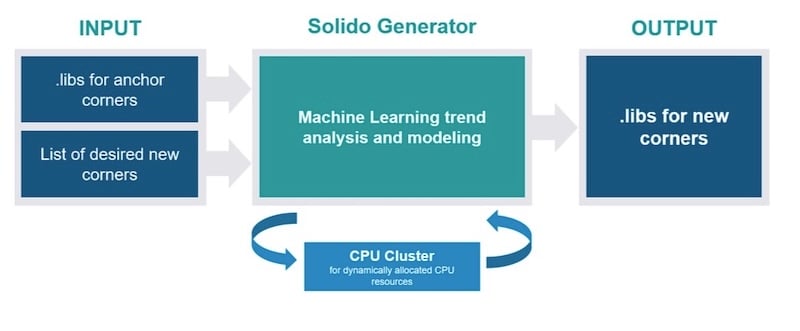
Solido Generator builds an AI model of the library to produce production-accurate .lib models at new PVT corners 100x+ faster than SPICE.
Solido Characterizer also works in tandem with Solido Generator, another component of the Characterization Suite. Generator uses baseline Liberty files produced by Characterizer to train AI models that produce additional library views without running SPICE simulation, generating new PVT libraries in minutes rather than the hours or days traditional methods require.
Together, Characterizer and Generator form an end-to-end library creation pipeline that addresses both the initial characterization bottleneck and the scaling challenge of producing libraries across large PVT matrices.
Early Adopters Report Production-Ready Results
GlobalFoundries has reportedly been using the tool in its design enablement workflows. James Culp, fellow in Design Enablement at GlobalFoundries, said the team validated and created design margins and libraries of excellent quality, maintaining production accuracy correlated to SPICE models while achieving a 20% to 30% speedup within internal flows. Culp said the adoption process was quick and straightforward, and that the team delivered signoff-ready margins and Liberty files for multiple high-profile customers across several GlobalFoundries technologies.
Anatrix, a provider of radiation-hardened digital gate libraries, has also deployed Solido Characterizer for its single-event latch-up radiation-hardened IP. Greg Pauls, president of Anatrix, said that silicon testing verified post-layout parasitic simulations using the Siemens EDA flow accurately predicted IC behavior, reinforcing trust in the results and supporting first-pass silicon success.
Solido Characterizer is available now and supports standard cell, I/O, memory, and custom cell characterization and handles all Liberty data types, including timing, power, noise, and variation across NLDM, CCS, LVF, and Moments data structures. The software is part of Siemens' broader Solido Custom IC portfolio, which spans SPICE simulation, variation-aware verification, and IP validation.
All images used courtesy of Siemens.

EA-CHIP INDUSTRY CO., LIMITED
-
Tel
+86 180 2549 2789 -
Wechat