BOM
BOM Cart()
 English
 Russia
 Korean
Intel introduced the 8051 in 1980 as the flagship of its MCS-51 family, a single-chip microcontroller designed to fold an entire control computer into a single 40-pin package. The instruction set was the work of Intel engineer John Wharton, who drew up the architecture as a successor to the company's earlier 8048.

The Intel 8051. Image used courtesy of Konstantin Lanzet via Wikimedia Commons (CC BY-SA 3.0)
On a single die, the 8051 combined an 8-bit CPU, 4 KB of program ROM, 128 bytes of RAM, two 16-bit timers, a full-duplex serial port, and 32 lines of digital I/O. For the cost-sensitive embedded designs of the era—the appliances, instruments, and peripherals that needed a brain but not a full computer— that level of integration was the entire point.
A Computer on 40 Pins
The 8051 used a Harvard architecture, keeping program and data memory in separate address spaces so the CPU could fetch an instruction and access data without contention. Around the 8-bit ALU sat four switchable banks of working registers, which let an interrupt service routine swap its whole register context in a single instruction rather than pushing and popping values one at a time. Five interrupt sources are fed into a two-level priority scheme.
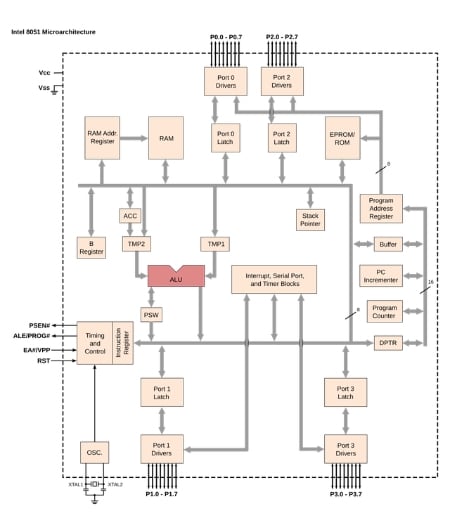
The Intel 8051’s microarchitecture. Image used courtesy of Appaloosa via Wikimedia Commons (CC BY-SA 3.0)
The feature that set the part apart was its Boolean processor. The 8051 could test, set, and clear individual bits directly, with 210 bit-addressable locations spread across RAM, the register banks, and the I/O ports.
Control work is full of single-bit decisions: reading one sensor line, toggling one relay, checking one status flag. The 8051 mapped those operations onto single instructions instead of byte-wide masking and shifting. The original part ran at up to 12 MHz and used 12 clock cycles per machine cycle, so a 12-MHz device executed most instructions in one microsecond. Intel built the first versions in NMOS, then moved to CMOS with the 80C51, which sharply reduced power consumption for battery-powered and always-on designs.
Cloned, Licensed, and Synthesized
Few architectures have been copied as widely as the 8051. Intel second-sourced and aggressively licensed the design. Atmel extended and re-implemented the core, adding flash program memory to the AT89C51. Philips (and its NXP successor), Siemens, Infineon, and Silicon Labs followed suit. So did Dallas Semiconductor with faster one- and four-clock cores.
Closer to home, Intel built out the family itself with the 8052, which doubled ROM to 8 KB, raised RAM to 256 bytes, and added a third timer. The 8751 featured 4 KB of UV-erasable EPROM in a windowed ceramic package, allowing developers to reprogram it during design. That breadth made the MCS-51 instruction set one of the most widely implemented in the industry's history.
The interesting part, however, is where you can find it today: the 8051 survives less as a chip you buy in a tube than as a soft-IP block, a small synthesizable core dropped into USB controllers, mixed-signal ASICs, and system-on-chip designs where it handles housekeeping while larger blocks do the heavy lifting. In essence, an engineer can license the core, fold it into silicon, and never think of it as an 8051 at all.
So, Why Did It Endure?
A processor designed in 1980 has no obvious business operating in the 2020s. However, the 8051 endures because the qualities that mattered then still matter in embedded control: it’s simple, deterministic, cheap, and documented to exhaustion. By various industry accounts, the 8051 and its derivatives have shipped on the order of two billion units—a figure that’s necessarily approximate but speaks to how thoroughly the part saturated its market.
What kept it alive wasn’t its capabilities; faster, wider, more capable microcontrollers arrived within a few years and never stopped arriving. The 8051 persisted because it was small enough for one person to understand completely and predictable enough to trust in a product expected to run untouched for a decade.
Like the best jellybean parts, it never needed to be the most powerful option in the catalog. It only needed to be good enough, available everywhere, and the same this year as last, which it has managed for more than four decades.

EA-CHIP INDUSTRY CO., LIMITED
-
Tel
+86 180 2549 2789 -
Wechat