BOM
BOM Cart()
 English
 Russia
 Korean
Today, Cadence announced AuraStack AI Super Agent, running on the Allegro AI Studio platform. It introduces the industry's first full-flow agentic AI environment for PCB and advanced packaging design, delivering a 2X faster time to market and up to a 15X leap in engineering productivity.
As next-generation AI infrastructure scales across hyperscale data centers, autonomous vehicles, and aerospace applications, the core engineering challenge has expanded far beyond the silicon die itself. Modern hardware performance is increasingly limited by the complex systems that connect, power, and cool those chips.
Engineering teams designing advanced packages and printed circuit boards (PCBs) find themselves caught in a web of fragmented design tools, siloed workflows, and manual iterations. According to Cadence data, hardware engineers spend roughly 65% of their day simply navigating these disconnected tasks and cross-domain handoffs rather than actively designing.
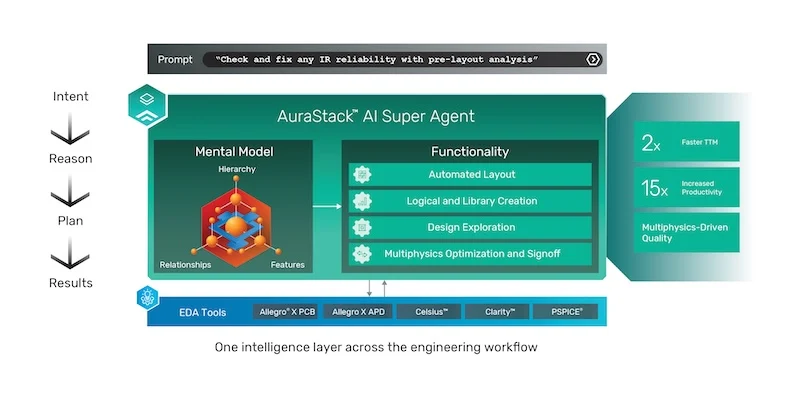
The AuraStack AI Super Agent for PCBs, advanced packaging, and electronic system design.
While a complex 3-nanometer or 2-nanometer chip might take 9 to 10 months to realize due to mature design automation, finalizing the accompanying advanced system package can drag on for over 12 months. Aurastack PCB was designed to break this systemic bottleneck.
To learn more about AuraStack PCB, we talked with Vivek Mishra, Corporate VP, System Design and Analysis Group at Cadence.
The Bottleneck: Engineering Intelligence vs. Point Automation
For decades, EDA tools have successfully automated isolated point tasks—such as running an IR drop simulation or calculating trace impedance. However, the true bottleneck remains the human orchestration required to stitch these workflows together.
When a layout engineer finishes a board layout, it is traditionally "thrown over the wall" to a mechanical or thermal specialist. If a Celsius thermal analysis or a Sigrity signal integrity simulation flags a violation, the layout must be manually modified, restarting the verification loop.
AuraStack shifts this paradigm from simple task automation to true engineering intelligence. Operating as an AI-native layer over Cadence’s trusted design and analysis tools, AuraStack leverages an underlying "mental model" of design intent. Instead of waiting for a user to trigger individual tools, the system understands the relationships between design constraints, supply chain realities, and physical layouts, orchestrating workflows concurrently.
"The agentic AI democratizes engineering knowledge,” says Mishra. “It can ask ‘Do you want me to set up your thermal analysis?' and then it will set up your thermal analysis for you, whereas before that engineer might not know how to do it."
Inside the Three-Layer Architecture
AuraStack’s framework is structured as a unified "three-layer cake" that integrates accelerated computing, native physics engines, and conversational AI:
- The Orchestration Layer: The top layer features the agentic AI workflow. AuraStack accepts conversational natural language prompts (supporting multiple languages, including English, Japanese, and Korean) to autonomously establish goals, evaluate engineering tradeoffs, and execute multi-step modifications across domains.
- The Physics Layer: The core consists of Cadence’s trusted multiphysics simulation and signoff engines. This includes the Celsius Thermal Solver, Clarity 3D Solver for 3D-EM, Sigrity X for signal and power integrity, alongside MSC Nastran and Marc for linear and non-linear mechanical stress, drop, vibration, and fatigue analysis.
- The Compute Layer: The foundation is powered by custom accelerated hardware, leveraging NVIDIA Blackwell GPUs and NVIDIA CUDA architectures via the Cadence Millennium M2000 supercomputer platform.

Cadence’s “three-layer” cake approach to designing for AI and using AI for design
By running these layers within a closed-loop environment, multiphysics analysis transitions from a late-stage gatekeeper to an active, real-time design guardrail.
From Intent to Implementation: A Closed-Loop Case Study
To demonstrate how the super agent manages full-flow system design, Cadence shared with us a demo of a cost-optimization workflow for a complex 5G smartphone board featuring a 66-page schematic and a 10-layer stack-up.

AuraStack AI Super Agent: agentic PCB workflow demonstration
Using natural language commands, a designer can navigate a complete optimization and layout sequence entirely orchestrated by the AI:
1. Supply Chain and Bill of Materials (BOM) Optimization
When prompted to optimize the design's BOM for cost, AuraStack acts with supply chain awareness. It analyzes discrete components, identifies redundancies, and recommends consolidating package types, yielding an immediate 28% reduction in component cost.
2. Autonomous Component Sourcing and Library Creation
When identifying alternative components, if a verified library model for a recommended power management IC (PMIC) is missing from the local database, AuraStack initiates a sub-agent. This agent locates the component from web content providers, extracts geometric and pin data directly from a raw PDF datasheet, and automatically generates the schematic symbol and footprint to update the design file.
3. Continuous Multiphysics Guardrails
Following component placement, the AI coordinates placement and routing agents while simultaneously running background simulations. During automated placement, a Celsius thermal analysis may flag structural hotspots. Rather than waiting for a manual review, AuraStack automatically calculates layout alternatives, presenting the designer with placement modifications that satisfy the thermal envelope before routing begins.
4. Interactive Place and Route
Designers can query the agent to identify unrouted high-speed nets, such as MIPI differential pairs. AuraStack analyzes existing constraints, automatically routes critical clock traces, routes the remaining interconnections, and ensures the layout passes all design rule checks (DRCs). A final post-layout evaluation extracts topology to simulate signal integrity, confirming the eye-opening meets strict operational specifications.
Industry Leaders Validate the Agentic Shift
Cadence says it is actively deploying AuraStack across prominent partners in the semiconductor, automotive, and industrial sectors, revealing significant performance gains. For its part, Nvidia has said that the Cadence AuraStack Al Super Agent and the Millennium M2000 Supercomputer enabled up to 20X faster multiphysics performance.
In advanced packaging environments, multi-die system layout times present a major schedule risk. Through a multi-year development collaboration focused on automated substrate routing, Cadence reports that TSMC notes that its deployment has allowed customers to unlock a 100X productivity boost in trace implementation while matching the quality of rigorous manual routing.
The automotive sector is seeing similar structural improvements. According to Cadence, Forvia Hella reported that utilizing the platform's AI-assisted component placement reduced a tedious 300-component placement task—which historically required up to four days of manual engineering layout—down to just four minutes.
Capturing Institutional Engineering Expertise
By capturing decades of institutional engineering expertise and embedding it directly within an automated, hardware-accelerated loop, it appears that AuraStack can ensure that complex design adjustments converge natively. This minimizes late-stage design revisions and helps teams safely navigate the tight thermal and electrical margins of modern system-level designs.
Vishhra notes that AuraStack can meet the needs of engineers across all levels.
“AuraStack makes junior engineers more like middle-level engineers, and middle-level engineers into senior engineers, senior engineers into super engineers."
All images used courtesy of Cadence.

EA-CHIP INDUSTRY CO., LIMITED
-
Tel
+86 180 2549 2789 -
Wechat