BOM
BOM Cart()
 English
 Russia
 Korean
In 1977, Texas Instruments introduced the TL07x family. The dual version, the TL072, became one of the most widely used operational amplifiers in audio electronics.
The breakthrough that followed was all in the manufacturing, with TI's BiFET process placing junction field-effect transistors on the same monolithic die as bipolar transistors, enabling the company to put a JFET input stage in front of a conventional bipolar gain and output stage.

The TL072. Image used courtesy of Mouser
That combination fixed the main weakness of the bipolar op amps that came before it, the 741 and 1458, whose input stages drew enough current to load down high-impedance sources and add noise where designers least wanted it.
JFET Inputs, Bipolar Muscle
With a JFET input, the impedance climbs to roughly 1012 Ω, a thousand times higher than a typical bipolar part, and input bias current drops into the pA range. For a signal coming from a high-impedance source—a guitar pickup, a piezo element, or a high-value resistor in a filter—those numbers mean the op amp can read the voltage without dragging it down or bleeding it away. A bipolar input would load such a source and inject bias current that turns into offset and noise.
The TL072 (datasheet linked) pairs that input with respectable speed for an inexpensive part: a slew rate of about 13 V/µs and a gain-bandwidth product near 3 MHz, comfortable enough for audio with margin to spare. It runs on supplies up to +/-18 V, giving the headroom that line-level and effects circuits need, and it comes in an 8-pin package as a dual, with the single TL071 and quad TL074 filling out the family.

Functional block diagram of the TL072. Image used courtesy of Texas Instruments
The 07x grade was the low-noise, tighter-offset version of the broader 08x line, and that combination—JFET inputs, low noise, wide supply range, and a price low enough to use without thinking—is what made it a default part rather than a specialty one.
The Op Amp in the Signal Path
Walk through the schematic of a guitar pedal, a synthesizer, or a small mixer from the past four decades, and the odds of finding a TL072 are high. The gold-era Klon Centaur, one of the most analyzed overdrive pedals ever made, uses a TL072 in its gain stages.
Versions of the Ibanez Tube Screamer have used the part as well, though in a clipping pedal, the diodes do most of the tone-shaping work, and the op amp simply has to stay out of the way. The TL072 also appears throughout synthesizer designs of the 1980s and in the modern Eurorack modular scene, where its high input impedance suits the high-value, control-voltage circuits that move slowly and mustn’t be loaded.
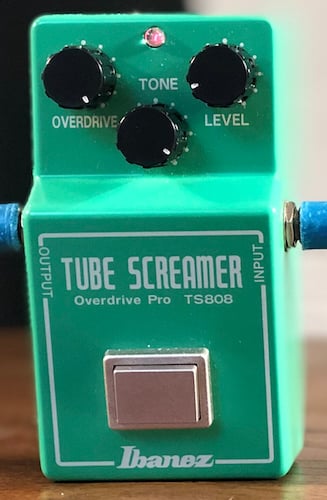
An Ibanez Tube Screamer. Image used courtesy of Guitar Chalk via Wikimedia Commons (CC BY 2.0)
It is worth saying, though, what the part isn’t. The bipolar NE5532, the other great audio jellybean, has lower voltage noise and drives low-impedance loads harder, which makes it the better choice for line-level stages, mixer summing buses, and balanced outputs where source impedances are low and the priority is the quietest possible path.
The TL072 wins on the other side of that trade, where source impedance is high and bias-current loading would corrupt the signal. The two aren’t interchangeable by accident, and a designer who understands the difference reaches for one or the other deliberately. The folklore of a distinctive "TL072 sound" is mostly that; the part is prized for being neutral and getting out of the way rather than for any coloration of its own.
Still in Mass Production
The TL072 remains in mass production today, second-sourced by several manufacturers and stocked by every distributor, proving how well the original design hit its mark. Faster, quieter, and more exotic op amps have arrived steadily since 1977, and many of them are better on paper in one dimension or another. None displaced the TL072 from its niche, because the part was never trying to be the best at any single specification.
Instead, what it offered was balance: high input impedance, low noise, enough speed, generous supply range, and a price that let an engineer scatter a dozen across a board without a second thought. For high-impedance audio, that combination has never needed improving, which is why a chip designed in the late 1970s is still the first part most builders solder into a new pedal or module.

EA-CHIP INDUSTRY CO., LIMITED
-
Tel
+86 180 2549 2789 -
Wechat