BOM
BOM Cart()
 English
 Russia
 Korean
The 4N35 is one of those parts that almost every electronics engineer has used, but most never give passing thought to. Registered as a JEDEC standard part in the early 1970s and built ever since by Motorola, Vishay, Onsemi, Broadcom, and others, it’s a phototransistor optocoupler in a 6-pin DIP, and its job is simply to pass a signal from one circuit to another without any electrical connection between them.
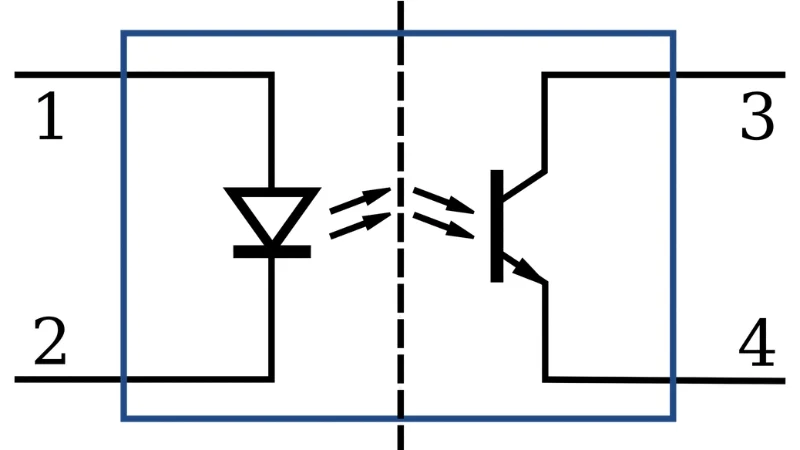
A schematic diagram of an opto-isolator showing the source of light (LED) on the left, the dielectric barrier in the center, and a phototransistor on the right. Image used courtesy of Inductiveload via Wikimedia Commons (Public domain)
Inside the package, an infrared LED shines across a tiny gap at a silicon phototransistor. Drive the LED, and the transistor conducts; the information crosses, but the two sides never connect. That simple arrangement solved a problem that shows up everywhere, from industrial controls to switching power supplies: it allows two circuits to talk while keeping them electrically isolated.
A Light Beam Across a Barrier
The 4N35 provides galvanic isolation, with the input and output sharing no conductive path, so a voltage difference, a ground loop, or a transient on one side doesn’t propagate to the other. In terms of isolation voltage, the 4N35 is rated to withstand on the order of 5,000 V RMS between input and output, enough to separate low-voltage logic from line-powered or noisy high-voltage domains and to provide a safety barrier between a user-facing circuit and the mains.
The other key figure is the current transfer ratio, which is the proportion of LED current that reappears as collector current in the phototransistor. The 4N35 guarantees a CTR of at least 100%, meaning the output transistor passes at least as much current as the LED draws, which makes the part easy to design around without elaborate biasing.
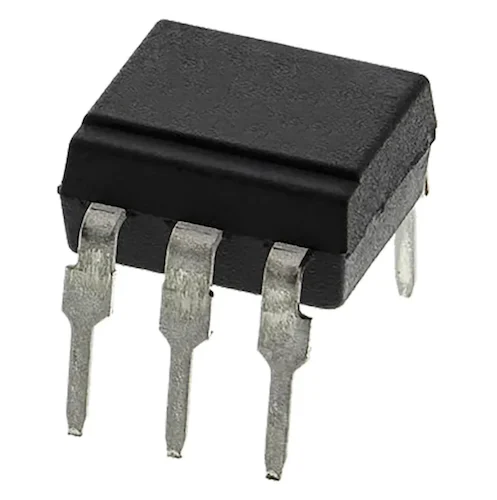
The 4N35. Image used courtesy of RS Components
A typical design lights the LED with a few milliamps through a series resistor, well under the 50-mA maximum, and reads the transistor's switching at the output. The part also brings the phototransistor's base out to pin 6, allowing a designer to add bias or adjust sensitivity as needed.
The one real limitation, however, is speed. With switching times in the microsecond range, the 4N35 is comfortable in the tens of kilohertz but no faster, so it suits control and signaling rather than high-rate data.
Isolation’s Jellybean Component
Those modest specifications turned out to be exactly right for an enormous range of jobs. The 4N35 isolates a microcontroller from the power stage it commands, so a fault on the motor or heater side can’t reach back and destroy the logic.
It drives the gates of triacs and SCRs in mains switching circuits, carries the feedback signal across the isolation barrier in switching power supplies, and breaks ground loops in audio and instrumentation where two grounds at slightly different potentials would otherwise inject hum. Anywhere a digital signal needs to cross a boundary between voltage domains, an optocoupler is the obvious tool, and for decades, the 4N35 was the optocoupler of choice.
Its ubiquity owed as much to its standardization as to its design. Because the 4N35 was a JEDEC-registered part rather than a single company's proprietary product, it was available from many manufacturers with consistent pinouts and ratings, so a designer could specify it without being locked to a single supplier.
That multi-source availability, combined with a price that rounded to nothing, made it the part that appeared in textbooks, in application notes, and in the isolation section of nearly every introductory course. Even the world of musical instruments leaned on the same principle: the MIDI standard required every input to be optically isolated so that connected gear couldn’t form ground loops through the cable, and optocouplers of the 4N35's class were a common hobbyist choice for building those inputs.
Fending Off Modern Competitors
Newer technology has steadily encroached on the 4N35's territory. Faster digital optocouplers handle high-speed data that the older part can’t. A generation of capacitive and magnetic digital isolators now does the same job with smaller size, higher speed, and tighter tolerances, displacing optocouplers in many new designs. None of that has retired the 4N35, though; it remains in production from multiple vendors, and engineers still reach for it when a design simply needs a few isolated control or signaling lines without fuss.
The 4N35 endures for the same reason any good jellybean part does. It’s cheap, it’s everywhere, it’s understood, and it does one clearly defined thing reliably. An LED and a phototransistor staring at each other across a sliver of air is not a sophisticated idea, but it’s the idea that taught a generation of engineers what isolation means, and it still works.

EA-CHIP INDUSTRY CO., LIMITED
-
Tel
+86 180 2549 2789 -
Wechat